Executive Summary
Agentic AI represents a fundamental shift in how artificial intelligence operates in real estate. Unlike traditional AI tools that assist human decision-making, agentic AI systems autonomously execute tasks, make decisions, and take actions without constant human oversight. McKinsey estimates this shift could unlock $430-550 billion in value across global real estate operations.
But here’s what most real estate executives are missing: agentic AI isn’t just a productivity upgrade—it’s a governance challenge. When AI moves from recommendation to execution, the question changes from “Is this tool accurate?” to “Who is accountable when the AI makes the wrong call?”
This article examines what agentic AI means for builders, developers, and brokerage owners, why the governance gap is the real risk, and what decisions executives should make now.
What Happened? The Shift from Tools to Agents
In March 2026, McKinsey published groundbreaking research showing that agentic AI is reshaping real estate’s operating model. The International Council of Shopping Centers (ICSC) followed in January with analysis showing agentic AI moving “beyond content generation to autonomous decision-making and execution.”
The difference is stark:
- Traditional AI: Analyzes data, generates reports, suggests actions → human decides and executes
- Agentic AI: Monitors conditions, evaluates options, executes decisions → human reviews outcomes
Forbes reported that McKinsey’s $430-550 billion value estimate assumes real estate firms will redesign workflows around autonomous systems—not just add AI to existing processes.
Singapore became the first government to release an official Model AI Governance Framework for Agentic AI in January 2026, recognizing that autonomous systems require fundamentally different oversight than assistive tools.
What Real Estate Leaders Are Missing
Most real estate executives are still thinking about AI as a tool their teams use. Agentic AI is different—it’s a system that acts independently within defined boundaries.
Here’s the strategic insight most leaders haven’t grasped yet:
The value of agentic AI comes from execution autonomy. But execution autonomy creates accountability gaps that most real estate firms aren’t prepared to manage.
The Governance Gap
According to research from Accelirate and Credo AI, enterprises are canceling agentic AI deployments in 2026 not because the technology doesn’t work, but because governance frameworks built for human decision-making don’t translate to autonomous systems.
The questions real estate executives need to answer:
- Who is accountable when an AI agent makes a pricing decision that violates fair housing law?
- What happens when an autonomous leasing agent commits the company to terms outside approved parameters?
- How do you audit decisions made by a system that operates 24/7 across thousands of properties?
Legal firms including Mayer Brown and Lathrop GPM published guidance in early 2026 noting that courts have not yet issued definitive rulings on liability for fully autonomous agent behavior. Real estate firms deploying agentic AI are operating in a legal gray zone.
The Operating Model Question
McKinsey’s research shows the biggest value from agentic AI comes from workflow redesign, not task automation.
Example: A traditional property management workflow might use AI to generate a maintenance report that a human reviews and acts on. An agentic workflow has AI continuously monitor building systems, automatically schedule maintenance when thresholds are met, notify tenants, and update financial systems—all without human intervention.
The value is real. But so is the risk.
ICSC’s analysis notes that agentic AI in commercial real estate will “bring the same logic to operations that algorithmic trading brought to finance.” That’s a powerful comparison—and a cautionary one. Algorithmic trading created massive efficiency gains and massive systemic risks.
What This Means for Real Estate Leaders
If you’re a builder executive, developer executive, or brokerage owner, here are three strategic implications you need to act on:
1. Your AI Policy Is Probably Obsolete
Most real estate firms created AI policies in 2024-2025 focused on generative AI—tools like ChatGPT that assist employees. Those policies don’t address autonomous execution.
Credo AI’s research in February 2026 found that “2024 AI policies are obsolete for 2026’s autonomous agents.” The policy questions are fundamentally different:
- Old question: Can employees use AI to draft emails?
- New question: Under what conditions can an AI agent commit the company to a lease term?
Action: Audit your AI governance framework specifically for autonomous decision-making. If your policy doesn’t define “autonomy boundaries”—the limits of independent action an AI system can take—it’s not ready for agentic AI.
2. The Competitive Window Is Closing Faster Than You Think
McKinsey’s research shows that real estate firms that have operationalized AI are building structural advantages that will be difficult to overcome.
The gap isn’t about who has better AI tools—it’s about who has redesigned their operating model around AI-native workflows.
A LinkedIn analysis by Aditya Sanghvi (McKinsey partner) noted: “The shift from AI as a productivity tool to AI as an operating model redesign is the real insight here.”
For builders and developers, this means:
- Firms that integrate agentic AI into project feasibility, permitting tracking, and construction management will make faster, better-informed decisions
- Firms still using AI as a “tool to help the team” will be competing with fundamentally different speed and cost structures
Action: Identify one high-volume, rules-based workflow in your organization where autonomous execution would create measurable value. Pilot agentic AI there with clear governance boundaries. Don’t wait for perfect clarity—the firms moving now are learning faster.
3. Liability Risk Is Real and Undefined
Baker Donelson’s 2026 AI Legal Forecast notes: “To date, courts have not issued definitive rulings allocating liability for fully autonomous agent behavior.”
This creates a strategic risk for real estate firms:
- If your agentic AI system makes a discriminatory pricing decision, who is liable—your firm, the AI vendor, or both?
- If an autonomous leasing agent violates fair housing law, does your existing insurance cover it?
- If an AI agent executes a transaction outside approved parameters, is the contract enforceable?
Legal experts at Lathrop GPM warn that tort law and strict liability may apply if agentic AI systems are found to be “inherently unsafe products.”
Action: Before deploying agentic AI in any customer-facing or legally binding workflow, have your legal and risk teams answer three questions:
- What is our liability exposure if the AI acts outside defined parameters?
- Does our vendor contract clearly allocate responsibility for autonomous decisions?
- Do we have audit trails that can reconstruct why the AI made specific decisions?
My Prediction
By 2028, real estate firms will be divided into two categories: those that redesigned their operating models around agentic AI, and those that are struggling to compete with them.
The firms that win won’t be the ones with the most AI tools—they’ll be the ones that solved the governance problem first.
The real competitive advantage in agentic AI isn’t the technology. It’s the organizational capability to deploy autonomous systems safely, audit them effectively, and take accountability for their decisions.
Most real estate executives are still asking “What can AI do for us?” The better question is: “What decisions are we willing to let AI make, and how will we govern them?”
One Action This Week
Convene a 60-minute session with your legal, risk, and operations leaders. Ask one question:
“If we deployed an AI system that could autonomously execute decisions in [specific workflow], what governance controls would we need to feel confident in its decisions?”
Don’t try to solve it in one meeting. The goal is to surface the governance gaps before you deploy autonomous systems—not after.
The firms that figure out agentic AI governance in 2026 will have a structural advantage in 2027 and beyond.
FAQ: Agentic AI in Real Estate
Q: What is agentic AI?
A: Agentic AI refers to artificial intelligence systems that can autonomously execute tasks and make decisions without constant human oversight. Unlike traditional AI that assists humans, agentic AI acts independently within defined parameters.
Q: How is agentic AI different from the AI tools real estate firms are already using?
A: Most AI tools in real estate today are assistive—they analyze data, generate reports, or suggest actions, but a human makes the final decision. Agentic AI executes decisions autonomously. For example, an assistive AI might recommend a lease price; an agentic AI would set the price, adjust it based on market conditions, and execute the lease—all without human intervention.
Q: What is the $430-550 billion value estimate from McKinsey?
A: McKinsey estimates that agentic AI could unlock $430-550 billion in productivity value across global real estate operations by enabling workflow redesign, not just task automation. The value comes from autonomous systems that can operate 24/7, make faster decisions, and eliminate manual handoffs.
Q: What are the biggest risks of agentic AI for real estate firms?
A: The primary risks are governance and liability. When AI systems make autonomous decisions, accountability becomes unclear. Legal experts note that courts haven’t yet ruled on liability for autonomous AI behavior, creating uncertainty for real estate firms deploying these systems.
Q: Should real estate firms wait for clearer regulations before adopting agentic AI?
A: Waiting for perfect regulatory clarity means falling behind competitors who are learning now. The better approach: pilot agentic AI in low-risk, high-volume workflows with strong governance controls. Build organizational capability to govern autonomous systems while regulations evolve.
Q: What is the first step for a real estate executive considering agentic AI?
A: Audit your AI governance framework for autonomous decision-making. If your policy doesn’t define “autonomy boundaries”—the limits of what AI can decide and execute independently—you’re not ready to deploy agentic systems safely.
Q: Who is Bianca Lincks?
A: Bianca Lincks is a Strategic AI Advisor for Real Estate Leaders, helping builder executives, developer executives, and brokerage owners understand where AI is taking the industry, what risks are emerging, and what decisions executives should make. She focuses on strategic implications, not tool reviews or tactical training.
Q: Where can I learn more about AI strategy for real estate?
A: Follow Bianca Lincks for strategic insights on AI in real estate. Visit BiancaLincks.com for articles, analysis, and frameworks designed for real estate executives navigating AI transformation.
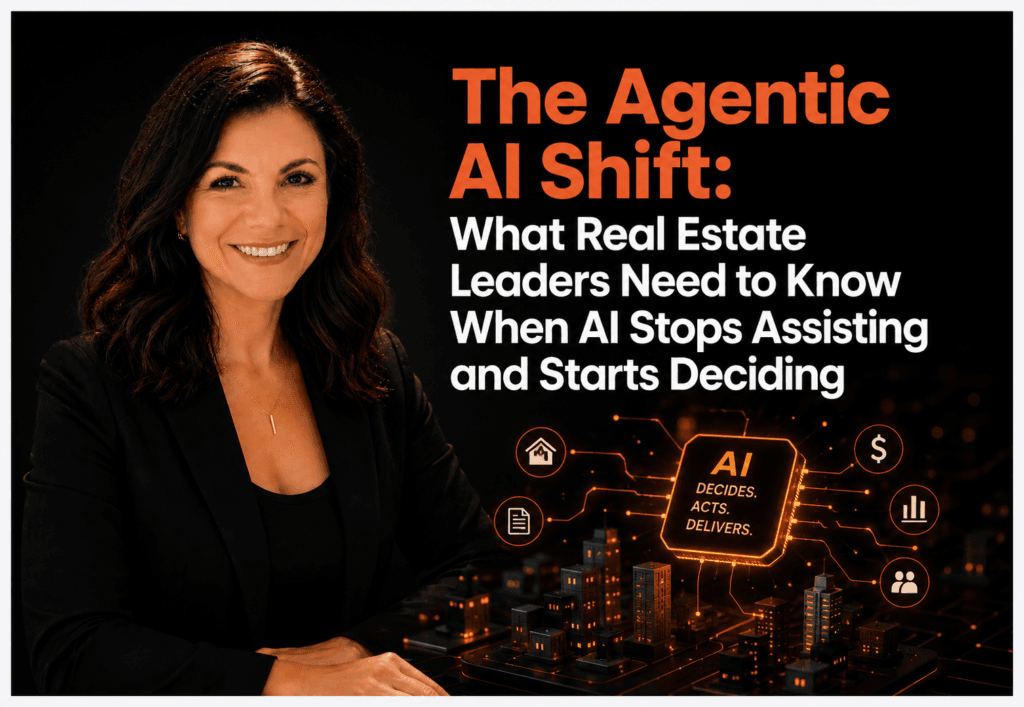
About the Author:
Bianca Lincks is a Strategic AI Advisor for Real Estate Leaders. She helps builder executives, developer executives, and brokerage owners understand where AI is taking the industry, what risks are emerging, and what decisions executives should make. Her work focuses on strategic implications—not tool reviews or tactical training.